Convenience at a Cost: What Mobile Car Wash Services Are Really Doing to Your Vehicle's Finish
There is a particular appeal to watching a van pull into your driveway and transform your vehicle without requiring you to leave home. Mobile car wash and detailing services have grown considerably across the Midwest, and Appleton is no exception. Busy schedules, limited weekends, and the general fatigue of errand-running make the proposition genuinely attractive. But convenience, as a purchasing criterion, has a habit of obscuring what is actually happening to your vehicle during and after that service.
This is not a dismissal of every mobile operator in existence. Some are skilled, well-equipped, and operate with genuine professionalism. The concern is systemic — rooted in the structural limitations that mobile services face regardless of individual operator quality — and it deserves a candid examination.
The Water Problem Most Customers Never Consider
Professional facility-based detailing relies on controlled water supplies: filtered, temperature-regulated, and consistent in mineral content. Mobile units, by contrast, typically draw from whatever source is available — residential tap water, outdoor spigots, or pre-filled holding tanks that may have been sitting for extended periods.
Hard water, which is common across much of Wisconsin, contains elevated levels of calcium and magnesium. When used in vehicle washing without proper filtration, these minerals leave behind water spots that etch into clear coat over time. A single wash with high-mineral content water may not cause visible damage immediately, but repeated exposure creates a cumulative effect that professional paint correction later struggles to fully reverse. The irony is that customers paying for a cleaning service may be financing gradual paint degradation without realizing it.
Filtered water systems represent a meaningful capital investment, and not all mobile operators maintain them properly — or at all.
Chemical Runoff and Surface Compatibility
Detailing chemicals are not universally safe for all surfaces, and their behavior changes depending on ambient temperature, dwell time, and the substrate they contact. Inside a professional facility, technicians work in climate-controlled bays where product performance is predictable. A degreaser applied at 68 degrees behaves very differently than the same product applied on a sun-baked driveway in July or a frigid concrete pad in November.
Mobile operators working outdoors contend with these variables constantly, and without a controlled environment, they must either rush certain chemical applications or risk unpredictable results. Some operators compensate by using more aggressive products — stronger degreasers, higher-concentration protectants — that can strip wax, accelerate rubber degradation, or discolor trim if dwell times are not monitored precisely.
There is also the matter of runoff. Detailing chemicals that drain onto lawns, driveways, and storm systems carry environmental implications, and in many municipalities, commercial washing on residential property without proper containment may violate local ordinances. Homeowners are often unaware that the liability for improper chemical disposal can extend to the property owner, not just the service provider.
The Accountability Gap
When a facility-based detailer damages a vehicle — a swirl mark from improper pad selection, a trim piece dislodged during engine cleaning, a water intrusion from an improperly sealed door — there is a physical location, a business license, and an established accountability structure. Disputes have a venue.
Mobile operators exist on a wider spectrum of accountability. Larger franchise operations carry insurance and formal complaint procedures, but independent mobile services — which represent a significant portion of the market — may operate with minimal documentation, verbal-only service agreements, and no fixed business address. When damage occurs after the van has departed, recourse becomes considerably more complicated.
This is not speculation. It is a pattern that professional detailers in fixed facilities encounter regularly when customers arrive with paint damage, chemical burns on leather, or trim discoloration that they attribute to a recent mobile service visit.
Technique Consistency and Equipment Limitations
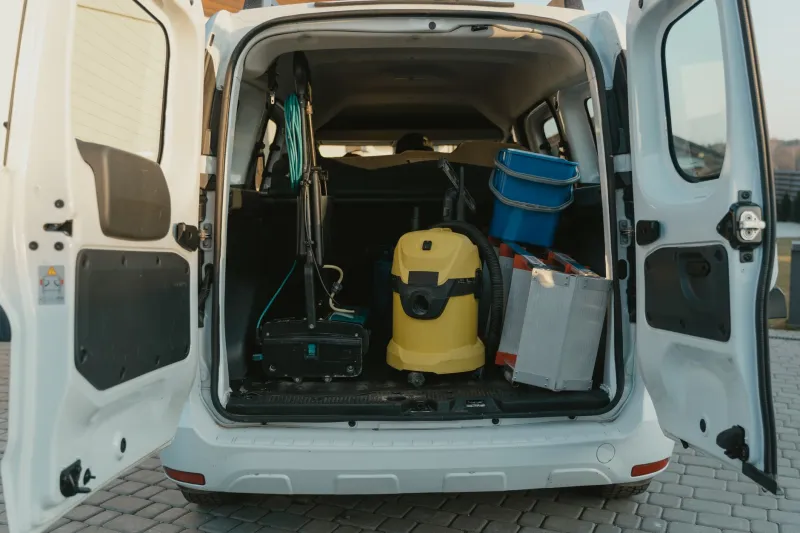
High-quality detailing requires more than capable hands. Paint decontamination, clay bar treatment, multi-stage polishing, and ceramic coating application each demand specific equipment maintained to precise standards. Mobile setups are constrained by what fits in a van and what can be powered by a generator or residential outlet.
Polishing machines require consistent power delivery. Extraction equipment used for interior deep cleaning requires adequate suction and water recovery. Steam systems used for sanitization require sustained temperature thresholds. When these systems are underpowered or improperly maintained, the results are compromised — not dramatically in most cases, but subtly in ways that compound over time.
A vehicle that receives six mobile details per year may look reasonably clean after each visit while accumulating micro-marring from underpowered polishers, residual chemical contamination from incomplete rinse procedures, and progressive clear coat thinning from abrasive products applied without paint thickness measurement.
What Appleton's Climate Demands From a Detailing Service
Wisconsin winters are not gentle on vehicles. Road salt, freeze-thaw cycling, and the grit accumulation that persists from November through March create conditions that require thorough, methodical decontamination — not a surface-level rinse. Spring detailing in particular demands a comprehensive approach: clay bar treatment to remove embedded contamination, inspection of paint depth before any polishing, and sealant or coating application under stable environmental conditions.
These procedures are difficult to execute reliably outdoors in variable weather. A mobile service arriving in early April faces ambient temperatures, humidity levels, and wind conditions that directly affect how products cure and bond. The controlled bay environment of a professional facility eliminates these variables, ensuring that protective treatments perform as intended rather than as circumstances allow.
The Honest Calculus
Mobile detailing is not inherently fraudulent or irresponsible. For routine maintenance washes on newer vehicles with intact paint protection, a reputable mobile operator can deliver adequate results. The problem arises when customers treat mobile services as equivalent substitutes for professional facility-based detailing — particularly for paint correction, coating application, or thorough interior restoration.
The cost comparison also deserves scrutiny. Mobile services appear less expensive at the point of transaction, but when factored against the cumulative paint damage they may introduce, the correction services those conditions eventually require, and the depreciation that improperly maintained paint contributes to at trade-in, the savings become considerably less clear.
For Appleton vehicle owners who have made a meaningful financial investment in their cars — and who understand that a vehicle's condition directly influences its appraised value — the controlled environment, accountable structure, and technical precision of a professional detailing facility represent the more defensible choice. Convenience is a legitimate preference. It simply should not come at the expense of the finish you are paying to protect.