Hard Water, Harder Lessons: How Appleton's Water Chemistry Is Undermining Your Vehicle's Finish
The Problem No One Mentions at the Car Wash
Walk into any national automotive retailer and the detailing advice is largely the same regardless of whether you live in Phoenix, Portland, or Appleton, Wisconsin. Rinse. Apply product. Buff dry. The assumption embedded in that guidance is that water is water—a neutral medium that simply carries soap and rinses away without consequence.
That assumption is wrong, and for drivers in the Fox Valley region, it carries a measurable cost.
Appleton's municipal water supply draws from the deep sandstone aquifers underlying northeastern Wisconsin. That geological reality means local tap water carries a significant dissolved mineral load—predominantly calcium and magnesium carbonates, with trace concentrations of iron and silica depending on seasonal variation and distribution zone. By most water hardness classifications, Appleton consistently ranks in the hard-to-very-hard range. What that means for your vehicle's finish is a conversation most detailing guides never bother to have.
What Happens When Hard Water Meets Automotive Paint
The chemistry is straightforward, even if the consequences are not immediately visible. When water evaporates from a painted surface, the dissolved minerals it carried do not evaporate with it. They remain behind, deposited in concentric rings that mirror the shape of each water droplet. These are water spots—and while the term sounds minor, the reality ranges from cosmetic nuisance to genuine paint damage depending on how long the deposits are allowed to bond.
Calcium and magnesium carbonates are alkaline compounds. Automotive clear coat, the protective layer sitting atop your vehicle's color, is a chemically sensitive surface. Prolonged contact between alkaline mineral deposits and clear coat initiates a process called etching—a chemical reaction that physically degrades the surface at a microscopic level. What begins as a spot that looks removable with a microfiber cloth can, over repeated exposure and time, become a permanent impression in the clear coat that requires machine polishing to address.
Silica deposits present a different but equally problematic challenge. Silica bonds tenaciously to painted surfaces and glass, forming a film that standard washing cannot dislodge. On glass, the result is reduced optical clarity. On paint, it creates a haze that dulls gloss and undermines the visual depth that distinguishes a well-maintained vehicle from a neglected one.
For Appleton drivers, this is not a theoretical risk. It is a recurring condition that affects every vehicle washed with untreated municipal water—whether at an automated car wash, a self-service bay, or in the driveway at home.
Why Generic National Advice Falls Short Here
Detailing content produced for a broad national audience is calibrated to average conditions. Average water hardness. Average seasonal temperature swings. Average environmental particulate levels. Appleton does not represent average conditions on any of those dimensions.
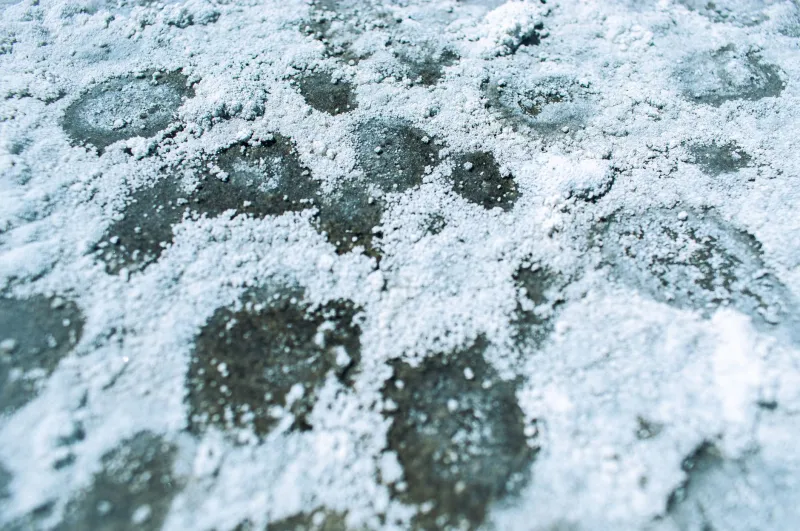
Beyond water hardness, the Fox Valley environment introduces additional variables that compound the challenge. Wisconsin's freeze-thaw cycle means vehicles spend months accumulating road salt, calcium chloride, and magnesium chloride from de-icing treatments—all of which interact with existing mineral deposits on paint and underbody surfaces. Summer humidity creates conditions where water sits on painted surfaces longer before evaporating, extending mineral contact time. Agricultural particulate from surrounding rural areas introduces additional contaminants that bond with water deposits and accelerate surface degradation.
A detailing protocol designed for Southern California or the mid-Atlantic corridor is not equipped to address these compounding factors. The products may be identical, but the environmental context in which they are applied is fundamentally different.
What Professional Detailers Actually Do About It
The professional detailing approach to Appleton's water quality begins well before a wash mitt ever touches a vehicle's surface. It starts with water treatment.
Professional-grade deionization systems strip dissolved minerals from water before it contacts paint. Deionized water—water from which ionic mineral content has been removed—evaporates from a surface without leaving deposits. It is, in practical terms, the elimination of the mineral transfer problem at its source rather than an attempt to remediate the damage afterward. The difference between washing a vehicle with untreated hard water and washing it with properly deionized water is not subtle. It is visible in the finish quality, the reduction in post-wash spotting, and the longevity of any protective coating subsequently applied.
Beyond water treatment, professional detailers working in this region employ pH-controlled chemical protocols that account for the alkaline character of local mineral deposits. Dedicated mineral deposit removers—distinct from standard car wash soaps—use mild acidic chemistry to dissolve calcium and magnesium carbonate bonds without compromising clear coat integrity. This is a targeted intervention that generic wash products are not formulated to deliver.
Paint decontamination, a process that combines chemical treatment with physical clay bar or clay mitt application, removes bonded silica and metallic contamination that survives conventional washing. In Appleton's environment, where road salt chemistry and agricultural particulate create complex contamination profiles, this step is not optional for vehicles receiving protective coatings. It is the foundation on which any ceramic coating or paint sealant depends for proper bonding and durability.
The Compounding Cost of Ignoring Local Conditions
Vehicle owners who rely on standard wash methods and generic detailing products are not simply failing to optimize their results. They are actively allowing a process of incremental surface degradation that accumulates over months and years. Each wash with untreated hard water deposits another mineral layer. Each summer of UV exposure accelerates the oxidation of a clear coat already compromised by alkaline etching. Each winter cycle adds road salt contamination on top of an insufficiently decontaminated surface.
The cumulative effect is a vehicle that looks older than its age—not because of how many miles it has traveled, but because of how consistently its finish has been exposed to conditions that generic maintenance protocols were never designed to address.
By contrast, a vehicle maintained with regionally informed professional detailing—deionized rinse water, appropriate chemical decontamination, and protective coatings applied to a properly prepared surface—retains its optical clarity, gloss depth, and structural finish integrity in ways that translate directly to perceived condition and, ultimately, appraised value.
Local Knowledge Is Not a Marketing Phrase
It is easy to dismiss references to local expertise as promotional language. In the context of automotive detailing, however, the distinction between generic and regionally calibrated practice is not rhetorical. It is chemical, environmental, and financial.
Appleton's water is what it is. The aquifer geology that gives the Fox Valley its water supply is not going to change. What can change is how vehicle owners and the professionals they trust respond to that reality. Treating Appleton's detailing environment as though it were identical to the national average is not a neutral choice. It is a choice to accept preventable surface degradation as inevitable.
Professional detailing in this region means understanding the specific variables at work and deploying the appropriate responses—not because the equipment is more expensive, but because the knowledge informing how it is used is more precise. That precision is what separates a vehicle that holds its finish over a Wisconsin decade from one that quietly deteriorates wash by wash, season by season, mineral deposit by mineral deposit.