The Paint Protection Trap: How 'Adequate' Maintenance Is Quietly Draining Your Vehicle's Equity

There is a particular kind of financial loss that never appears on a bank statement. It doesn't trigger an alert, generate a receipt, or arrive as a bill in the mail. It accumulates quietly, over months and years, in the form of oxidized clear coat, embedded contaminants, and neglected paint surfaces — and it announces itself only once: at the dealership, when the appraiser hands you a trade-in offer that feels insulting.
For many vehicle owners across Wisconsin, that moment arrives as a genuine shock. The car runs well. The tires are relatively new. The oil has been changed on schedule. So why is the offer so low?
The answer, in most cases, is paint condition. And the misconception that allowed the damage to accumulate — the belief that basic washing constitutes adequate protection — is one of the most expensive myths circulating among American car owners today.
What Dealerships Know That Most Owners Don't
When a certified appraiser evaluates a trade-in vehicle, they are not simply assessing mechanical function. They are calculating the cost of reconditioning — the labor and materials required to bring the vehicle's appearance to a marketable standard before it can be placed on a used car lot.
That reconditioning cost is subtracted, in full, from your offer.
Industry reconditioning estimates from the National Automobile Dealers Association consistently place average used vehicle reconditioning expenses between $900 and $1,400 per unit. For vehicles with significant paint oxidation, swirl damage, or interior neglect, that figure climbs considerably higher. In competitive used car markets, where presentation directly influences days-to-sale, dealerships are not inclined to absorb those costs generously.
The math is straightforward: every dollar of reconditioning work your vehicle requires is a dollar removed from your trade-in valuation. The owner who maintained a professional detailing schedule, by contrast, presents a vehicle that requires minimal reconditioning — and negotiates from a position of visible, documented quality.
The False Economy of 'Good Enough'
The phrase most commonly heard when professional detailing comes up in conversation is some variation of: "I keep it clean. That's good enough."
It is worth examining what "clean" actually accomplishes at the paint chemistry level.
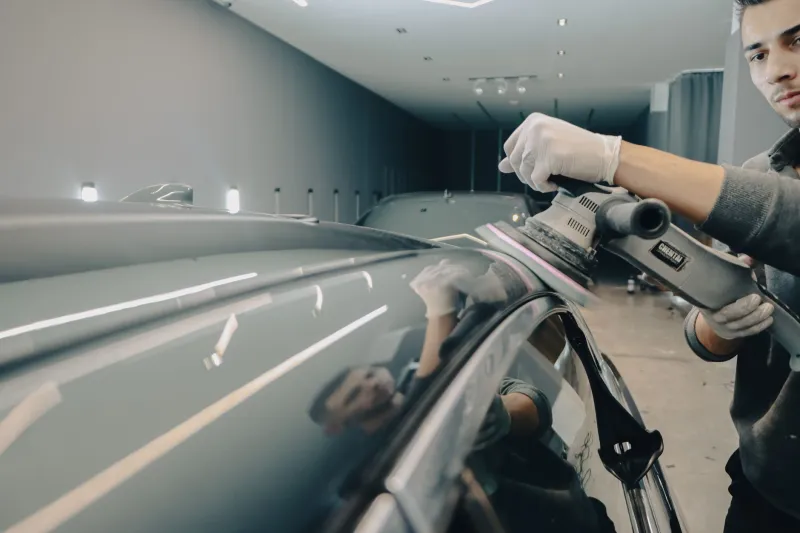
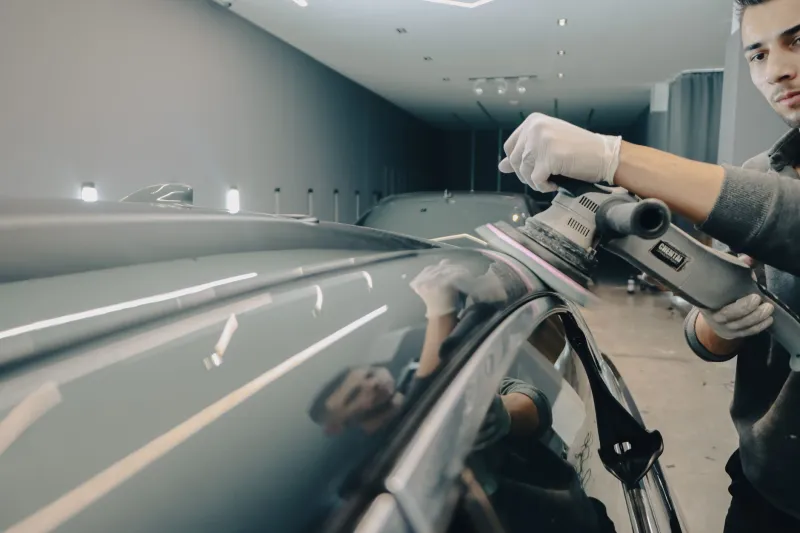
A standard car wash — whether performed at home or at an automated tunnel facility — removes surface-level dirt. It does not remove bonded contaminants such as industrial fallout, tree sap residue, or iron particles embedded in the clear coat. It does not address the microscopic scratches introduced by improper wash technique. It does not reverse UV oxidation, restore hydrophobic properties, or seal the paint surface against future environmental intrusion.
In Wisconsin specifically, the seasonal environment accelerates paint degradation at a rate that makes passive maintenance particularly inadequate. Road salt from November through March attacks clear coat and exposed metal simultaneously. Summer UV exposure in the Fox Valley region is sufficient to initiate visible oxidation on unprotected surfaces within a single season. Without professional intervention — decontamination, paint correction, and protective coating application — each passing year compounds the accumulated damage.
"Good enough" is not a stable condition. It is a trajectory.
The $500 Investment That Prevents a $3,000 Loss
Consider a representative scenario: a 2019 midsize sedan purchased new for $32,000, maintained with regular oil changes and occasional car washes, and traded in after four years of ownership.
Kelley Blue Book and similar valuation platforms assign condition grades — Excellent, Good, Fair, and Poor — that carry significant dollar differentials. The spread between "Good" and "Excellent" condition on a vehicle in this price range typically ranges from $1,800 to $3,200, depending on make, model, and current market demand. The spread between "Fair" and "Good" is often comparable.
A vehicle maintained with annual professional detailing — including paint decontamination, single-stage correction where needed, and a quality sealant or ceramic coating — will consistently grade higher at appraisal than one maintained with washing alone. The visual difference is immediately apparent to any trained appraiser: the paint clarity, the absence of swirl patterns under inspection lighting, the condition of trim and glass all signal whether a vehicle has been genuinely cared for.
A comprehensive professional detail at Appleton Car Detailing, performed annually over four years of ownership, represents an investment of approximately $400 to $600 per service depending on the selected package. Against a potential valuation differential of $2,000 to $3,000 at trade-in, the return is not merely positive — it is substantial.
This does not account for the additional negotiating leverage that a well-documented, visually pristine vehicle provides in private-party sales, where condition premiums are even more pronounced than in dealership transactions.
The Dealership Reconditioning Arbitrage
There is a secondary dimension to this calculation that rarely receives attention.
When a dealership acquires a trade-in vehicle in substandard cosmetic condition, it does not absorb the reconditioning cost as a loss. It performs the work — or contracts it out — and prices the vehicle to recover that investment, plus margin. The used car buyer pays the full reconditioning cost, embedded in the retail price.
The original owner, meanwhile, received a reduced trade-in offer that effectively transferred the reconditioning expense to them in the form of lost equity.
In this transaction, the dealership profits twice: once by undervaluing the trade-in, and again by marking up the reconditioned vehicle for retail sale. The owner who neglected professional detailing has, in practical terms, subsidized the dealership's reconditioning department.
This is not a cynical observation about dealership ethics — it is simply how used vehicle economics function. The owner who understands this dynamic and maintains their vehicle accordingly is the one who exits the transaction with the most favorable outcome.
What Professional Detailing Actually Preserves
Beyond the transactional arithmetic, professional detailing preserves something that is difficult to quantify but immediately recognizable: the perception of value.
Vehicles that present well — paint that reflects cleanly, interiors that show no embedded staining or odor, glass that is optically clear — communicate to buyers and appraisers alike that the owner treated the vehicle with care. That perception translates directly into willingness to pay, whether the buyer is a private individual or a dealership appraiser completing an offer sheet.
At Appleton Car Detailing, we work with vehicle owners throughout the Fox Valley region who understand that a car is not merely transportation — it is a depreciating asset that can be managed intelligently. Professional detailing is one of the few maintenance investments that actively defends against that depreciation curve rather than simply accepting it.
The owners who protect their paint protect their equity. Those who settle for adequate maintenance discover, at trade-in, exactly what "adequate" was worth.
The gap between those two outcomes is measurable, significant, and entirely preventable.