Your Car Wash Is Wrecking Your Paint: A Guide to the Three Damage Types Most Drivers Never Recognize
The Convenience That Comes at a Cost
For the majority of American drivers, the weekly car wash is a routine errand — a quick stop between work and the grocery store, a satisfying ritual that sends a vehicle back onto the road looking reasonably clean. The appeal of the automated tunnel wash is straightforward: it is fast, inexpensive, and requires no effort whatsoever.
What that transaction rarely includes is any disclosure of what those rotating brushes, recycled water, and careless rinse cycles are actually doing to your paint over time. At Appleton Car Detailing, we regularly inspect vehicles whose owners are genuinely surprised to learn that the dull, scratched, and chemically stained finish they are looking at was largely caused by the very cleaning services they paid to maintain it.
The damage falls into three distinct categories, each with its own cause, its own appearance, and its own level of difficulty to correct. Understanding all three is not a matter of being overly precious about your vehicle. It is a matter of protecting an asset that depreciates with every cosmetic shortcut taken.
Swirl Marks: The Signature of Careless Friction
Swirl marks are perhaps the most recognizable form of wash-induced paint damage, yet many drivers mistake them for a natural characteristic of their paint color rather than evidence of accumulated mechanical harm.
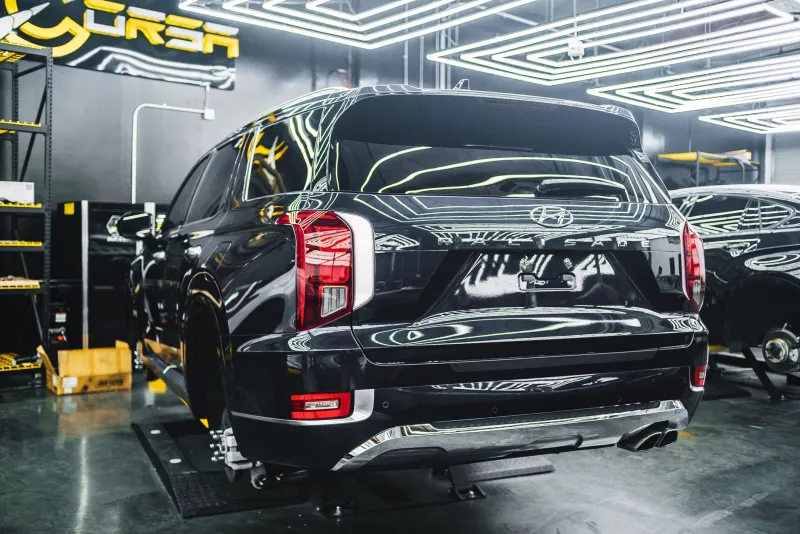
Under direct or angled sunlight, swirl marks appear as fine circular or web-like scratches that seem to radiate outward from a central point. On dark-colored vehicles — black, navy, dark gray, and deep burgundy — they are particularly pronounced, giving the paint a dull, spiderweb appearance that no amount of waxing will eliminate. On lighter colors, they are subtler but present nonetheless.
The source is friction applied with insufficient lubrication or inappropriate materials. Automated car wash brushes are the primary culprit for many drivers. These brushes contact hundreds of vehicles per day, accumulating dirt, grit, and debris in their bristles. When they make contact with your paint, they drag that abrasive material across the clear coat under mechanical pressure. Each pass creates microscopic scratches. Individually, each scratch is imperceptible. Collectively, after dozens of wash cycles, the cumulative effect is a finish that has lost its reflective clarity entirely.
Budget hand-wash services can produce identical results when workers use the wrong microfiber grade, apply excessive pressure, or fail to rinse panels thoroughly before making contact. A single pass with a contaminated wash mitt can introduce swirl marks that require machine polishing to correct.
The professional approach eliminates this risk through a combination of proper technique and appropriate materials. Two-bucket wash methods, high-quality microfiber media, and adequate lubrication throughout the process are non-negotiable standards that automated washes and rushed detailing operations simply do not meet.
Water Spots: The Mineral Damage Hidden in Plain Sight
Water spots are deceptive. To the untrained eye, they look like a minor inconvenience — the kind of thing that will disappear with a quick wipe-down. In reality, the spots you can see on the surface of your paint are symptoms of a chemical process that has already occurred within and on the clear coat.
When water evaporates from a vehicle's surface without being properly dried, it leaves behind the minerals it carried in suspension. Calcium, magnesium, and various other dissolved solids present in municipal and well water concentrate as the water evaporates, depositing a residue that bonds to the clear coat. In mild cases, these deposits sit on the surface and can be removed with professional decontamination products. In more severe cases — particularly when the vehicle is exposed to repeated wetting and drying cycles without intervention — the mineral deposits etch into the clear coat itself, creating permanent surface damage.
Automated car washes contribute to this problem in two significant ways. First, many facilities use high-mineral water in their rinse cycles. Second, their drying systems — typically high-velocity air blowers — are designed for speed, not thoroughness. Vehicles frequently exit these facilities with standing water in recessed areas, door handles, mirror housings, and body panel seams. As the vehicle drives away and that water migrates across the paint surface and evaporates, the mineral deposition process begins.
For Wisconsin drivers, this issue is compounded during winter months when road salt and chemical deicer residue mix with wash water and accelerate the etching process on both paint and glass surfaces. A vehicle that appears clean after a winter tunnel wash may actually carry a thin film of mineral and chemical residue across its entire surface.
Proper professional drying — performed by hand with clean, high-absorbency microfiber towels, section by section — eliminates standing water before it can evaporate and deposit. It is a step that takes time and cannot be replicated by a blower tunnel.
Overspray: The Silent Contamination Most Drivers Cannot Identify
Of the three finish killers discussed here, overspray is the least understood and, in some respects, the most insidious. Unlike swirl marks and water spots, overspray does not originate exclusively from the wash process itself. It can arrive from any number of sources: nearby road construction, fresh asphalt application, industrial fallout, agricultural spraying operations, or careless application of tire dressings and protectant sprays during budget detailing services.
Overspray from detailing products is particularly common and particularly avoidable. When tire dressings, rubber protectants, or interior silicone sprays are applied without adequate masking or controlled application techniques, fine droplets settle onto painted surfaces and glass. These droplets cure onto the surface, creating a textured, slightly rough contamination layer that is distinct from the paint itself.
The telltale sign of overspray is a roughness that persists after washing. Running a clean hand across a properly maintained paint surface should feel smooth. A surface contaminated with overspray will feel like fine sandpaper — a sensation that most drivers attribute to road grime but that does not resolve with standard washing.
Professional decontamination using clay bar treatment is the appropriate remedy for overspray that has not yet etched into the clear coat. The clay bar physically lifts and removes bonded surface contaminants without abrading the paint beneath. This process is a standard component of professional detailing preparation and is entirely absent from automated wash operations.
Recognizing the Cumulative Effect
What makes these three damage types particularly harmful is their tendency to compound one another. A paint surface roughened by mineral deposits and overspray accumulates dirt and grit more readily, which in turn increases the abrasive damage caused by subsequent washing. A clear coat weakened by swirl marks is more susceptible to chemical etching from water minerals. The cycle accelerates with each careless wash.
The drivers who maintain genuinely exceptional finishes year after year are not necessarily those with the most expensive vehicles. They are the ones who recognize that cleaning a car incorrectly is often more damaging than not cleaning it at all — and who invest in professional care that treats the finish as the precision surface it actually is.
If your vehicle's paint no longer reflects with the depth and clarity it once had, the cause is almost certainly one or more of these three damage types. A professional inspection will identify what is present and what level of correction is appropriate before further damage accumulates.