What Dealers Are Actually Grading When They Walk Around Your Car

There is a moment every car owner eventually faces: standing in a dealership lot while an appraiser circles your vehicle with a clipboard, a practiced eye, and very little sentiment. What happens in those few minutes determines a number that will either work in your favor or quietly cost you money you never expected to lose.
Most people believe that number is driven almost entirely by mileage, mechanical history, and market demand. Those factors matter, but they are not the whole picture. Dealerships operate on resale logic, and the condition of a vehicle's surfaces, interior, and finish directly affects how they classify it—and how aggressively they discount the offer they extend to you.
Understanding what appraisers are actually looking for, and how professional detailing reshapes that evaluation, is one of the more straightforward financial decisions a vehicle owner can make before trading in.
The Appraisal Is a Reconditioning Estimate in Disguise
When a dealership appraiser walks around your car, they are not simply admiring or critiquing it. They are mentally calculating how much it will cost them to bring it to resale condition. Every scratch, every stained seat, every water spot on the glass, and every odor embedded in the headliner is a line item in their internal reconditioning budget.
That budget gets subtracted from your offer before you ever see a number.
Dealerships that intend to retail a used vehicle typically require it to meet a defined cosmetic threshold before putting it on the lot. Vehicles that fall short of that threshold either get wholesaled to auction—where prices are substantially lower—or they absorb a reconditioning cost that the dealer recovers by reducing the trade-in value.
In practical terms, a vehicle with significant paint swirling, faded trim, a stained interior, and a persistent odor may be categorized as an auction unit rather than a retail candidate. That reclassification alone can represent a difference of $1,500 to $3,000 or more, depending on the vehicle's segment and the regional wholesale market.
The Specific Inspection Points That Drive the Evaluation
Appraisers are trained to move through a vehicle systematically. While every dealership has its own internal process, the inspection points that consistently influence the final offer fall into several clear categories.
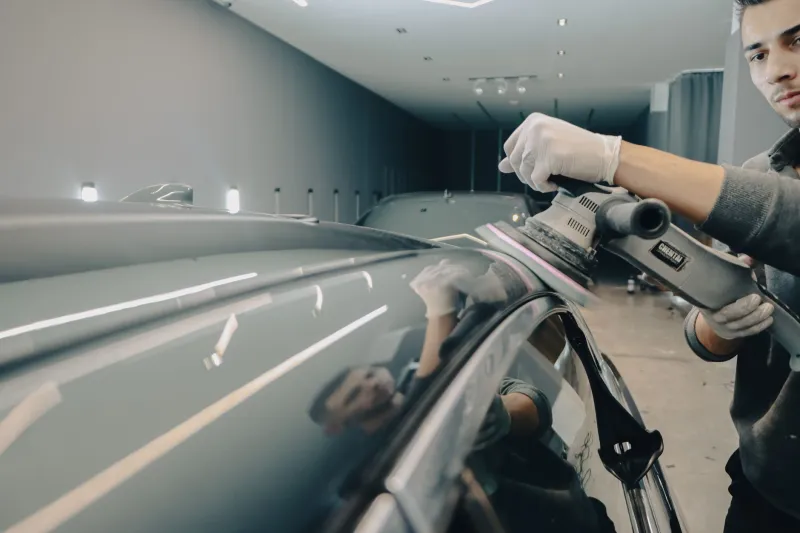
Paint condition is evaluated first and most visibly. Appraisers look for oxidation, swirl marks from improper washing, clear coat failure, and any scratches that penetrate beyond the surface layer. Light swirling that a professional detailer can correct through paint correction is often perceived by an untrained eye as permanent damage, which inflates the reconditioning estimate unnecessarily.
Glass and trim are inspected for water etching, cracks, fogging, and UV degradation. Faded plastic trim and pitted windshields are common deductions that many owners overlook entirely because they have become accustomed to them over time.
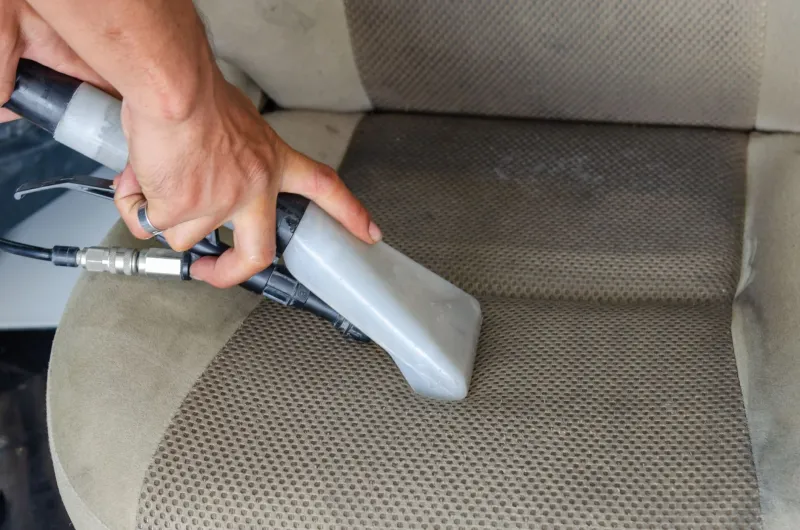
Interior surfaces receive close attention, particularly fabric or leather seating, door panels, and the headliner. Staining, cracking, discoloration, and wear patterns all factor into the evaluation. A leather interior with visible cracking and unaddressed conditioning damage will be treated as a reconditioning liability, regardless of how well the rest of the vehicle presents.
Odor is among the most penalizing factors in a trade-in appraisal, and it is also among the most underestimated. Smoke, pet dander, mildew, and food odors embedded in soft surfaces often require professional extraction and treatment to resolve. Dealerships know this, and they price it accordingly.
Wheels and undercarriage visibility round out the exterior assessment. Brake dust buildup, curb rash, and road grime on the lower panels signal to an appraiser that the vehicle has not been maintained with care—an inference that can affect their confidence in the mechanical history as well.
How Professional Detailing Shifts the Calculus
A thorough professional detail before a trade-in appraisal does not simply make a vehicle look better. It changes the category the vehicle is placed in during the evaluation.
A car that arrives clean, with corrected paint, treated interior surfaces, deodorized cabin materials, and dressed trim communicates something specific to an appraiser: this vehicle was maintained. That perception reduces the reconditioning estimate, increases the likelihood of a retail classification, and positions the owner to negotiate from a stronger baseline.
At Appleton Car Detailing, we work with vehicle owners in the Fox Valley region who are preparing for exactly this scenario. The services that most directly influence trade-in outcomes include paint decontamination and correction, interior deep cleaning and odor elimination, leather conditioning, and exterior trim restoration. These are not cosmetic indulgences—they are targeted interventions that remove the line items an appraiser would otherwise use to justify a lower offer.
The return on investment is straightforward to evaluate. A professional detail package in the range of $200 to $400 that results in a $1,000 to $2,500 improvement in trade-in value represents a meaningful net gain. That math holds consistently across vehicle segments, and it is the reason experienced car owners and fleet managers routinely detail before trading.
The Auction Floor Is Where Neglected Cars Go
It is worth understanding what happens to vehicles that do not meet a dealership's retail threshold. Most are sent to regional auto auctions, where they are purchased by independent dealers, wholesalers, or out-of-state buyers. Auction pricing is compressed by nature—buyers are bidding on volume, not individual vehicles, and they price risk conservatively.
A vehicle that might have retailed for $18,000 on a dealership lot could clear $14,500 at auction after fees. The dealership, aware of this spread, will offer you something closer to the auction floor when they classify your trade as a wholesale unit. That gap between retail classification and auction classification is the financial cost of arriving at an appraisal in neglected condition.
Professional detailing is not a guarantee of retail classification—mechanical issues, high mileage, and market demand all play independent roles. But for vehicles that are mechanically sound, detailing is often the deciding factor in how an appraiser categorizes the unit.
Preparing Strategically, Not Emotionally
One of the more common mistakes vehicle owners make before a trade-in is approaching the preparation emotionally rather than strategically. They may clean out personal belongings and run the car through an automated wash, but they stop short of the professional-grade work that actually moves the needle on the appraisal.
The dealership's appraiser is not moved by sentiment. They are working through a checklist, and every uncorrected defect is a documented reason to lower the offer. Approaching that process with a professionally detailed vehicle removes much of the leverage they would otherwise have.
If you are within thirty to sixty days of a planned trade-in, a professional detail is one of the highest-return preparations available to you. The work is methodical, the results are visible, and the financial outcome is measurable in a way that few pre-sale investments can match.
At Appleton Car Detailing, we provide that preparation with the same standards we apply to every vehicle that comes through our facility—because the result, whether it is a showroom finish or a stronger trade-in number, reflects the quality of the work behind it.